Why Incident Response Fails Before the Incident Starts
Most organizations think they’re “doing incident response” because they bought a tool. Or three. Maybe they even survived an incident once or twice, so clearly they’re fine now.
That’s not incident response. That’s luck with a Master Services Agreement.
Incident Response is usually described as four phases:
- Preparation
- Detection and Analysis
- Containment, Eradication, and Recovery
- Post-mortem
On paper, they look equal. In practice, they are the furthest thing from it.
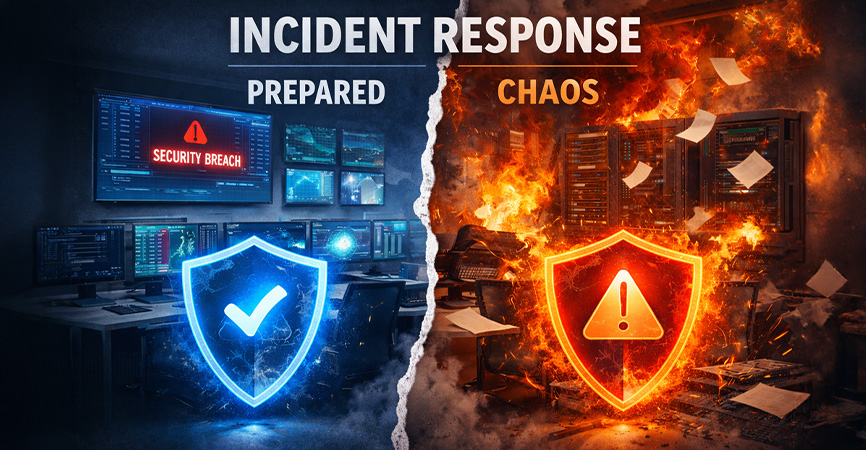
Most organizations pour their time, money, and attention into just detection and recovery. In fact, many think analysis is something that can be done later after the event is over, and not during the initial phases. So, they invest in the flashy parts. The dashboards. The alerts. The engineers heroically hand-jamming commands at 3 a.m., strung out on their fourth pot of coffee, while leadership asks for updates every fifteen minutes in a conference room littered with empty pizza boxes. And sometimes, despite all of that, they even ask, “Is a SIEM even really necessary?”
Then they wonder why the incident felt chaotic, expensive, and embarrassing.
Almost like no one decided how this was supposed to go ahead of time.
If it’s not abundantly clear by this point, if Phase 1 is weak, the rest of the lifecycle is just improvisation under stress. Detection without preparation is noise. Containment without preparation is panic. Recovery without preparation is guesswork.
If preparation is bad, everything downstream is significantly worse. I’ve seen it time and time again where folks dive head-first into phases two and three without taking the time to plan. Too often their arrogance and over confidence results in predictable outcomes: financial loss, reputational damage, and/or being fired as the MSP because of how the situation was handled.
One of the biggest mistakes organizations make is believing they need a “real” Incident Response plan before they can start. Something polished. Something comprehensive. Something perfect. Something worthy of being shared with auditors.
That belief is why most organizations have nothing.
Starting anywhere is better than starting perfectly. A short policy is better than no policy. A simple procedure is better than a shelf full of binders no one has opened since the last compliance review.
It bears repeating: something is better than nothing.
If your current Incident Response policy is a single page that says, “If something bad happens, call this person or this company,” Congratulations! (insert a relentless string of celebration emojis here) You’re already ahead of a terrifying number of organizations. But the good thing? You’ve at least answered the most important question: who owns the problem when things hit the fan.
This matters because incidents don’t wait for you to be ready. Threat actors don’t schedule attacks around your calendar or policy approvals. They don’t care that your documentation is incomplete or that your playbooks are still a work in progress. Incidents will happen anyway. The difference between success and failure is whether decisions have already been made before adrenaline enters the room.
That’s where executive buy-in and acceptance come in, and why they matter far more than any technical control.
Buy-in means leadership agrees incident response is important. Acceptance means leadership understands incidents will happen regardless. Without both, Incident Response plans quietly turn into compliance artifacts written for auditors, not responders, and auditors don’t show up at 2 a.m. to make decisions.
Yes, it is completely valid for an organization’s first procedure to be escalation. “We do not handle this internally. We call someone else immediately.” That is not failure. That is maturity. Knowing when you are outmatched is part of good planning.
Once even a basic policy exists, something interesting happens: conversations get easier.
- You can start defining what actually qualifies as an incident instead of arguing about it in real time while attackers move laterally.
This is where timeframes start to matter. Not because you need perfect SLAs, but because expectations kill confusion. How quickly do we escalate? How fast do we notify leadership? When does legal get involved? When does HR step in? If those answers aren’t written down, they will be debated during the worst possible moment instead of being executed.
Incidents don’t fail because engineers don’t know how to contain threats. They fail because nobody knows who is allowed to make decisions, or those who should be making the decisions just aren’t making them.
Once policy and procedure exist, you can start layering in playbooks. This is where most organizations want to start, and it’s exactly why most of them struggle.
Playbooks don’t replace planning. They depend on it.
A ransomware playbook is useless if no one knows who can approve taking systems offline. An email compromise playbook falls apart if escalation paths aren’t defined. A SOC can detect everything in the world, but if leadership freezes or engineers respond inconsistently, detection just becomes notification spam.
Playbooks are meant to give engineers confidence and consistency. They only work when the policy underneath them supports decisive action instead of ambiguity.
And here’s another uncomfortable truth: your Incident Response plan is never finished. Never. Ever. Ever.
That’s not a failure of planning. That’s the point of the Incident Response lifecycle.
The Incident Response lifecycle is a circle, not a checklist someone can pencil-whip. Planning feeds response. Response feeds lessons learned. Lessons learned feed planning again. Organizations that understand this get better over time. Organizations that don’t just keep buying better tools and repeating the same mistakes.
This is why “we handled the incident” is not the same thing as “we handled it well.”
In Part 2, I’ll talk about the phase everyone avoids: the post-mortem. Why it’s just as critical as planning. Why it only truly happens during live incidents or tabletop exercises. And why organizations that skip it never actually improve, no matter how good their detection looks on paper.
Spoiler: teams that succeed invest heavily in Phase 1 and Phase 4. Teams that don’t just get quicker to panic.